Hey! Check it out — my new fairy tale fantasy novel Violet and the Seven Dwarves just came out in paperback! It’s real…
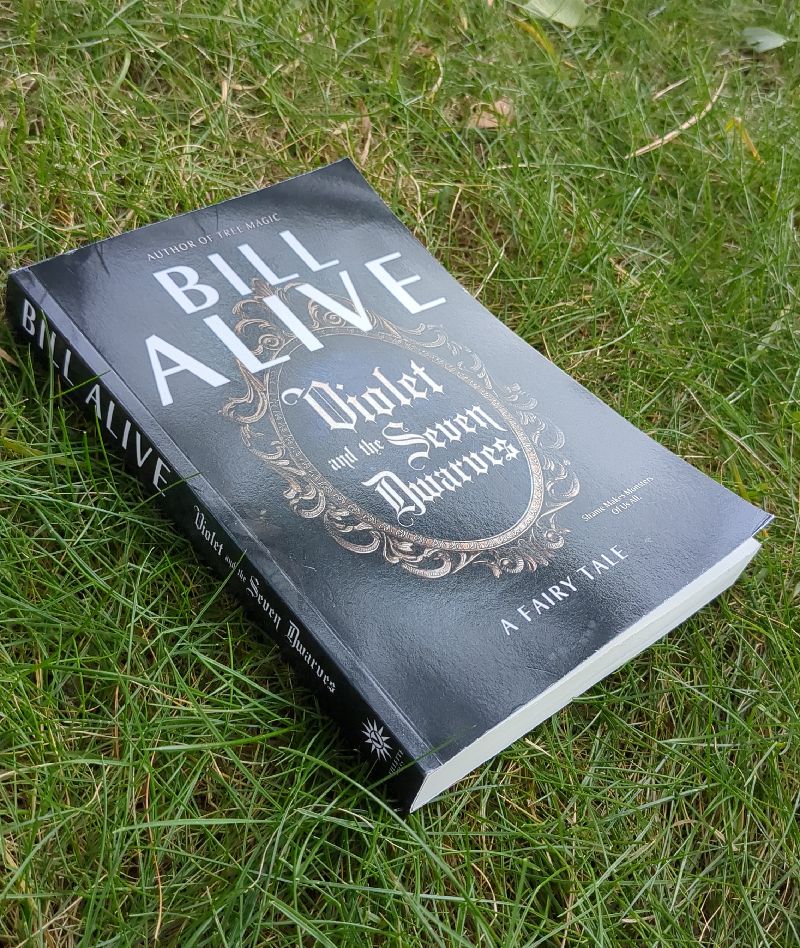
And what is this gorgeous book about, pray tell? I’m so glad you asked…
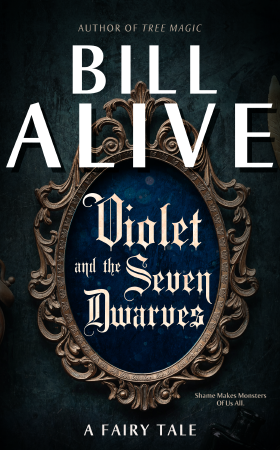
Violet and the Seven Dwarves
A Fairy Tale
From BILL ALIVE, the celebrated author of TREE MAGIC, comes a stunning new retelling of Snow White (and other fairy tales as well) in a splendid fantasy of rare power and magic.
In the little kingdom of Emlyn, deep in the dark and endless Forest, the Princess Violet slaves away as a wretched servant.
Trapped in the castle of her brutal, exquisitely beautiful stepmother, the Queen.
But Violet knows she deserves this fate. And worse. For all the rest of her days.
Because of her shame.
Her unwitting, ghastly offense.
Yet even so, in her innermost heart, Violet nurtures secret dreams of escape…
A fresh, lyrical, enthralling tale, full of magical surprises, searing heartbreak, and unexpected delights.
🛒 BUY IT NOW: Violet and the Seven Dwarves: A Fairy Tale
Click that link to purchase this e-book or paperback on any major online bookstore.
A PAPERBACK? WOW! CAN I BUY IT ANYWHERE BESIDES AMAZON?
Yes! When you click the link for this book, you’ll get multiple options, for both the epub and print editions:

… so … many … options …
So feel free to check it out, on your favorite online bookstore.
And if you’re still undecided, I’ve got a little treat for you below, in the P.S.. See what you think …
Happy reading!

Bill Alive
P.S. Okay, here you go! Why make you go click somewhere to start reading the book, when we’ve got plenty of room right here? Thanks to an excellent suggestion from a very helpful reader (thank you!), allow me to present a quite generous sample from the opening of this new novel, right here. Enjoy!
From Violet and the Seven Dwarves
Chapter 1: Queen
Nightmares woke the Queen, again. She found herself thrashing in her silken sheets, fighting to escape their soft, relentless grasp as if they were a winding shroud.
Her confused mind still thronged with the leering shadows of her dreamscapes; only a sliver of morning sun, peeking between the dark brocade of her bedcurtains, summoned her fully to the waking world. She yanked the curtains wide, and the dream shadows melted away in the sunlight, leaving her mind empty but her body steeped in panic, certain of coming loss and doom.
She rose, and wrapped a robe against the early morning chill. The high stone arch of her bedroom window framed a view of a clear sunrise promising fair weather; in the castle gardens below, her apple and cherry and plum trees seemed to have decked themselves overnight with even more bounteous garlands of pink and white blossoms. The sweet scent of the spring blooms reached up even unto her chamber, highest of all in the castle saving the watchtowers, yet she took no pleasure in the fragrance.
“Why should trees be granted eternal youth?” she muttered to herself. Her solitary voice sounded small in her cavernous room, and the ancient stone walls made no reply. “Be they gnarled as a crone in branch and root, every spring finds them freshly flowered as a maiden,” she grumbled on, as she slipped into silvery slippers and tread across a lush rug from a distant land that almost hid the hardness of the floor. “The added years only heap new glories, and the oldest dame of the forest is the loveliest of all.”
With a sigh, she sat herself at her mirror (not the Mirror, of course, not yet), and grimly faced the ravages of the night.
Clearly, she had not slept well.
The stains beneath her eyes had darkened even worse than usual. Nothing a bit of paint couldn’t hide, but the skin was also beginning to pouch distinctly, even sag. A cold tingle of horror clutched at her heart; even the finest paint in the kingdom was powerless to make such a flaw vanish smooth.
Her breath quickened. But she forced herself to slow.
Peace, she bid herself, with a stern frown that only aged her further. The Wizard would have a remedy, surely. And the Mirror would speak the truth.
She proceeded with her toilette, preparing herself for the ritual which sustained her. In past times, she would never have dreamed of performing such labors herself, with her own anointed royal hands. But all her maids seemed to have grown younger of late, smooth-faced and foolish as babes-in-arms, their eyes always laughing and mocking, (yes, mocking) no matter how well they managed to hold their tongues.
The Queen told herself that their prattle made her head ache, that she treasured this time of silence and peace before her duties called her to the tumult of the Court. But the truth was, she could no longer abide that any should see her person, from the girl who emptied the pot beneath her bed to the crone who attended her daily bath, no one, before she had dressed and faced the Mirror.
And as for aches in the head, she was suffering quite the specimen even now, without the aid of any voices whatsoever besides the harsh clamor of her own mind.
She pressed a slender finger against her forehead, feeling for the pain, and considered whether to resort to the remedy of the Wizard.
The secret vial, known only to them both, lay concealed in the most hidden chamber in her boudoir.
Pains of the head had afflicted her from her youth, and neither tincture nor physic nor leech of the doctors had ever lessened the dreadful ache. Even when her father, a Viscount, had caused discreet inquiries to be made of forbidden witches, the foul mixtures they’d provided had only upset her stomach. Many had been the day when the pain drove her near to madness, and small consolation had been her beauty then.
The coming of the Wizard had saved her life. Or, if not her life, certainly her sanity.
She had been young then, newly married to her first husband, a Duke, and heavy with his child while he was off fighting some petty baron. The pregnancy had been “difficult”, as the whey-faced old nurses put it; really, it had been one long agony. She had swollen like a pig’s bladder, and on most mornings even the smell of food would twist her ill.
But worst of all, by far, had been the unceasing torment in her skull. She began to fear that she must have somehow offended some secret witch, who had called forth an unseen fairy blade to be lodged ever in her brain.
Until the Wizard.
She would never forget that first morning, the first time she had swallowed the cold little charm. The effect had not come at once, oh no, and in those first few moments when the pain continued apace, perhaps even greater for all her attending to it, she had known some of the blackest despair of her young life. Had she been only a hair less desperate, she could have ordered his head off right then, in a justified fit of pique.
Thank the gods she had shown restraint! For she had dismissed him in a rage, and then turned her ire on the servants, and the Sun had crossed full high in the heavens before she paused for breath in her beratements and was stunned to realize: the pain was gone! She had forgotten even to think of her head.
She could have squealed like a girl for pure joy. Rare indeed, before or since, had she ever felt such bliss.
From thenceforth, the Wizard was always at her side. Or, at the least, within an hour’s summons. For he was a solitary man, and much inclined to his own private quarters, which he maintained in such absolute secrecy that even the Queen herself had never laid eyes on his bed.
Not that she would have been so inclined; though he was taller than most (nearly six feet), and his face gleamed with the light of his intellect, he was not at all handsome, and had already been well past the first bloom of youth when she met him. At most, she had been intrigued by his unusual girth. Most men of learning were gaunt as peasants, even when they could afford to revel to excess in their cups, yet the Wizard had sported an abundance of belly to rival her lordly husband. If the Duke had been inclined to spend more than a fortnight at a stretch in his own Court, he might even have prickled jealous.
At any rate, for all his odd habits and ways of speech, the Wizard had served her well now for, what, twenty years? No, more, for the son she had borne the Duke had now reached his majority, he was a grown young man.
At that word, man, she tensed, and the shaft of the headache deepened. “He is a man,” she hissed, through grit teeth, as if she were facing a full tribunal of accusers. “No matter what that foul Witch thinks she did.” She reflected, not for the first time, that she should have pressed her suit in the handling of that matter, instead of being prevailed upon by her advisors. Which reflection only made her headache worse.
Why did she not reach for the vial at once? Because the Wizard had greatly impressed upon her the need for restraint in the use of his remedies. Potent they were, like none other, but with that potency came the grave risk for harm, should they be used too much.
Also, the crafting of the remedy was slow and arduous. More than once, she had exhausted her supply, and been left to suffer helpless for days on end before the Wizard could ensure she was replenished.
And so she found herself in this strangest of predicaments, one she could not have imagined before she grew so familiar with the ways of magic. She had the power to end this pain, and yet, she had to consider whether to hoard this power against a future greater need. How little the common people knew, with their tiny little minds, when they imagined that the great of the earth could solve every problem with magic.
In the end, she decided, as she usually did when she had not yet faced the Mirror, that the pain was tolerable enough for now to save the remedy for later. Besides, she had dallied too long already.
When she was fully painted and dressed, in a long, sweeping gown of deep blue and silver that well complimented her golden tresses, she stepped slowly toward the curtain that concealed the tall, slender glass. (Or rather, concealed all else from its sight.) She drew herself to her full height, stretched forth her hand, and pulled away the veil.
The Mirror was encircled all about with ebony, and this black border teemed with carvings: devoted knights, jealous ladies, and rapturous peasants, as well as giants, trolls, fairies, and stranger creatures, even various enchanted animals and a sullen witch or two—in short, the full sweep of her subjects in miniature, all looking on at her reflection, all waiting for her, breathless and transfixed.
She would not keep them waiting further, nor the living spirit which waited in truth. In her low, resonant voice, the Queen spoke the chant that would keep her sane, so long as the spirit answered well.
Mirror, mirror on the wall.
Who is the fairest one of all?
Then, as ever, she lowered one thin finger to the Oracle, the small sacred tabernacle that was enshrined on a shelf of pure silver beside the Mirror.
The Mirror had been a treasure in her family for generations, but only the Oracle of the Wizard had ensnared the invisible spirit which now looked out through this single eye of glass. Though slight of size, the diminutive capacity of the Oracle utterly belied the greatness of the spirit it housed within. Even the Wizard had admitted that he had not wrought this wonder with his own hands; the craftsmanship was not of this land, perhaps not of this world.
Across the top of the tabernacle rose a row of crenellations, like the ridge along a castle wall. But by some cunning artifice, each individual crenellation could be depressed, sunk straight into the tabernacle until, with a click, it somehow latched an internal mechanism, and stayed flat. The Wizard had called these “buttons”.
She pressed the button marked PLAY.
And then, in that pale, scratchy, unearthly voice that always, always gave her a chill, and could only ever be the voice of a true spirit, the Oracle spoke:
Thou, O Queen, must understand,
Thou art fairest in the land.
Ladies rise, and ladies fall,
Some are short and some are tall.
Stout or slender, rich or poor,
In the end, they’re all a bore.
Only one can still enthrall:
Thou, the fairest one of all.
Forever.
She shuddered with relief, and sighed with pleasure.
All was well.
For today, at least.
With the blessing of the Oracle, the vision of herself that now greeted her in the Mirror seemed almost to glimmer with a fairy glamour.
What matter that this fast-approaching summer would be her fortieth? The bright gold of her hair might be somewhat the result of private artifice these days, but the hair was still her own, and abundant. Her lean face was still resplendent with the cheekbones that had moved many a court musician to fulsome verse. And her eyes? Her eyes were still blue pools of wonder, deeper than the sea, in which many a man at Court had declared himself happily drowned.
Why quibble over tiny flaws—a wrinkle here, a sag there—which could only ever suffer notice in the most minute inspection by the most fastidious and ungenerous of lovers? Though she was reverent and cautious enough not to say so out loud, she knew the truth at the core of her heart: she was a Goddess.
A mortal Goddess, yes, doomed for a time to walk among men, perhaps to atone for some fault (hubris, perhaps?) that she had committed in her true nature among her peers in the firmament. But a Goddess nonetheless.
How else to explain such relentless beauty? Or her rise from her birth as the daughter of a lowly Viscount to claim the sole sway of the Throne?
Nor was her great tale yet all told, no, not even close. Not so long as even this spirit of the air must needs cry out in praise of her unearthly beauty. Her march along the path toward her grand destiny had barely even begun.
As she treasured and renewed these private thoughts, inwardly chanting the litany of her secret faith, she realized, with a start, that her headache had vanished.
One more sign (as if she needed it!) of the divine favor that would surely continue to attend her all her days. In this moment, this one sweet moment, all her doubts were soothed and silent. She was, and would ever be, the Queen. The Queen of Beauty, the Lady of all Hearts, the undisputed Fairest in the Land.
Serenity befell her. She knew true, deep, engulfing peace.
Until she remembered her stepdaughter.
Chapter 2: Violet
Violet knew the ballroom was forbidden to her.
All the grand rooms of the castle were thus protected, every place where any of the nobility might chance to glimpse her curséd face, and be reminded of her disgrace. Thus might no person of quality suffer to lay eyes on the Princess who had brought shame on her kingdom, and her departed father, and most of all the Queen: the shame of being plain.
But every so often, Violet would creep along the servants’ stairs (so she still called them, though she had walked such paths as a servant herself these seven years and more, wearing their rough cloth and roughening her hands with their work) and sneak through the hidden door into this grand and empty hall, to savor the ballroom alone.
Though the Sun was only lately risen, and those such as the Queen were just rising from their beds, Violet had been working with the other servants for hours, grinding away at the hidden millstones on which the life of the castle turned. Just now she had striven hard with the scalding laundry, working fast as she might to defeat her pile so that she might steal these few breaths to herself before they looked for her in the vast and stinking kitchen. Her hands burned, for truth be told, she had been reckless, and more than once the steaming water had splashed across her flesh.
But this she counted as a small cost, as she stepped into this shrine to gaiety and light.
A wide bank of high, arched windows ranged along the outer wall, bringing the wide blue sky right into the very room. No other room in the castle, nay, all the little kingdom of Emlyn, except perhaps the cathedral, could boast such a wanton display of precious glass.
The light was pale, and sunless, for the ballroom had been constructed for evening revelry, and all these eyes looked west, toward spectacular sunsets, and afterward the stars. But although, in the reflected dimness of that gray morning, the ballroom might have seemed empty, chill, and bare, Violet stood in swirling memories of glittering candelabras and dancing lords and ladies, laughing like gods and goddesses at the pinnacle of the world.
These were the hours she could recall most clearly from when she’d been a fair child; after her mother had gone, yes, but before she’d grown into this wretched disappointment. Before she’d lost her father too.
Standing here, she could almost taste the delicacies she had long since been forbidden: the candied fruits, the frothy pastries, and most of all, the meat, chicken and venison and beef and boar piled high on the groaning tables, as if every beast of the forest had rushed to immolate itself on the spears of the hunters for the pleasure of the King. To this day, the smell of roasting in the kitchen was a torment to her, and reminded her most keenly that she was always hungry. But here, in the ballroom, savoring only memories, she could almost believe she was sated once more.
Nevertheless, the long oaken tables stretched bare along the tapestried walls, and the central floor for the dance lay empty and deserted. As she stood alone in that great field of stone, the pleasures of memory began to slip away, like mist between her fingers. All at once, the happy shades of revelers past were fading into nothing, leaving her no defense against the silent accusations of the walls.
For the windows had not been the only prodigious expenditure on glass in this house of pleasure.
Every wall gleamed with mirrors.
Long and wide, each framed in ornate brass, they ringed the hall like a circle of warding, as if the beautiful people held safely within need never risk a look beyond their own splendor. While the windows were high, and opened only onto the sky (for a view of the lands below, however striking, would inevitably remind one of the squalor of peasants, and duties best forgotten for a time) the mirrors met the eye wherever one turned.
This profusion of glass had been an unthinkable expense, long before her father’s time, in the days when the giants still paid tribute. The oldest of the gaffers among the servants loved to tell, with toothless grins, how their grandfathers had struggled mightily with each precious pane, and been warned again and again of what a perilous journey each glass had made from a distant land, and how one single shattering would cost the king more than their lives were worth on the open market.
That had been a cruel king (so different from her father), a terror to the giants and his subjects alike. None had doubted but that he would sell into service any fool who slipped, to whatever distant lord was fool enough to have them.
But not one glass had broken, and the ring was thus complete. And so, wherever Violet cast her eye, she must needs take care to avoid the sight of her own face.
She had come here only for the sweetness of memory, not the bitter truth of the woman she had become.
Should she relent and look, she knew well enough what she would see.
[END OF SAMPLE]
Thank you for reading this opening sample from VIOLET AND THE SEVEN DWARVES! Click here to get the complete novel and keep reading…